|

Three Little Wolves
Barks' first encounter with the animated cartoon work of
the Disney Studios was Three
Little Pigs from 1933 which he saw in the
local cinema. As fate would have it he was later - when
employed at Disney's - set to work as
an in-betweener on a sequel called Three Little
Wolves from 1936. |
|
|

Clyde in 1911 Despite the fact that
Barks ended up being a father, a grandfather, and a
great-grandfather none of the offspring are named Barks.
The only
branch of the family still maintaining the Barks name derives from
Carl's older brother Clyde (1899-1983). It is interesting that the
brother is also the only one with a middle name. His full name is
Clyde Hobson Barks. |
|
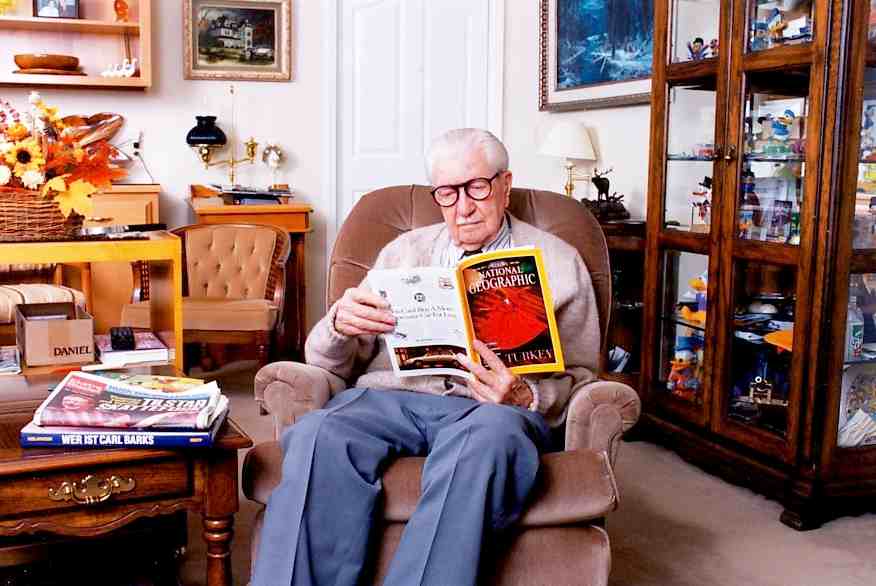
Barks was a long-term
subscriber to the National Geographic
Magazine from which he extracted an endless string
of ideas and background material especially for his duck adventure
stories.
In the later years the
publishers used to write 'valued
subscriber since 1935' on the invoices. |
|
|

Carl
and Monty
Carl and his wife Garé owned a teddy bear purchased
from a visiting professor from Montana
University. It was named Monty and during
the years it was given an increasingly
robust past fetched from the couple's vivid imagination,
like saying he rode shotgun on Wells Fargo stages over the
Bitterroots (incidentally, the bitterroot is the state flower of
Montana). |
|
|

The Gumps comic book
It is well known that Barks modelled
Scrooge McDuck after
Ebenezer Scrooge in Charles Dickens' Christmas
Carol.
But he also used Sidney Smith's character
Uncle Bim from The Gumps' daily strips
which premiered in 1917 (see more
HERE). Furthermore, he
- by his own admission - fashioned the
duck after himself... |
|
|

Truant
Officer Donald
Two of the Donald Duck many cartoons in which
Barks was involved as either scripter or Story Director were actually nominated for an
Academy Award (Oscar):
Good
Scouts from 1938 and
Truant
Officer Donald from 1941.
The winners those two
years
turned out to be Ferdinand the Bull and
Lend a Paw - both also from the Disney
Studios. |
|
|

Celebrating
Donald's 60th birthday June 9th in the Tivoli Gardens, Copenhagen
When visiting Europe for 6
weeks in 1994, Barks had a schedule so
tightly packed that it could easily have
broken a weaker man. He underwent a great
many official gatherings, numerous
interviews, and countless autograph
sessions. Although he was pleasantly surprised by
all the attention, he had to grit his teeth, because he would rather
have stayed at home... |
|
|
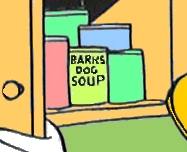
WDCS075 'The Turkey Shoot'
According to Garé,
her husband was generally disappointed
that he was not allowed to sign his
stories. From time to time he would sneak
in his signature or other means of
identification, but the attempts were
always discovered by his publisher and removed
before printing. Except for one: In this story he
smuggled in a can of Barks Dog Soup in Donald's kitchen cupboard
(close-up from the panel). |
|
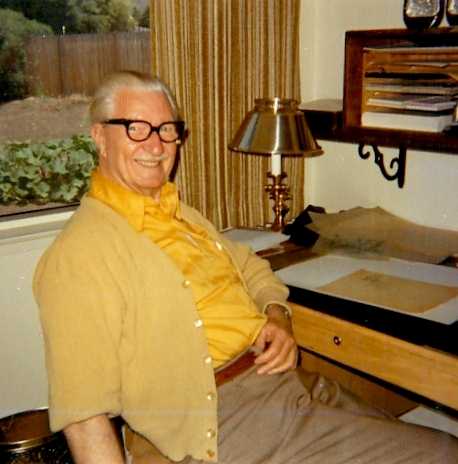
Every day of the week (except Sunday)
for the last decades of his life
Barks received many letters. Most of them were from fans, and Barks
felt obligated to respond to them all despite the huge cost in
paper and stamps, not to mention the painting time that was lost.
At
some point, answering his fan mail had gotten so time consuming that
Barks had to resort to different printed form letters in order to
give his fans a response. |
|
|

Barks' birthplace in the late 1990s
The farm where Barks was
born in 1901 is still standing. It is
situated about 5 kilometers northwest of
Merrill, Oregon.
In 1995 Barks returned to his homestead for the
first time since he had left it in 1918. He was accompanied by a
good friend who videotaped, while Barks photographed. They looked at the place
from a distance at the highway, but next time he was invited to have
a look around. He noticed some major alterations; a new dirt road
led to the farm and the main entrance was now moved to the back of
the house. But a shack from his childhood remained - barely! |
|
|

In October 1993 Barks
sent a letter to his daughter Dorothy (excerpt):
...I forgot to send a photo of myself in
my monkey suit (tuxedo) all a twitter to get down to the awards banquet
where I was one of the recipients of a Lifetime Achievement Award
for comic book creation. That was in Atlanta in June.
Next June I’ll
be receiving awards at several ceremonies in Europe, where Disney
comic books are much more popular than they are in this
country. I’ll be wearing the tux often. Pray for me...
|
|
|
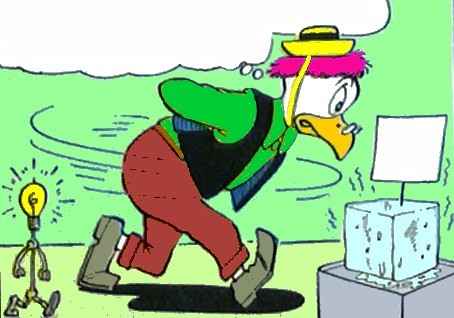
U$15 'The Cat Translator'
When Barks invented Gyro
Gearloose in 1952 he was only supposed to be an
occasional inventor character in the stories.
Later, when he became
enormously popular, Barks expressed his
vexation that he had not drawn him in a
simpler way, i.e. without hair, hat,
spectacles, and waistcoat.
Also, he admitted that it was
a mistake making Gyro twice as tall as most of the other primary
characters, because this resulted in grave difficulties fitting in
the speech balloons in the panels in a natural manner. |
|
|
Barks used to go to the local drug
stores in an attempt to see who actually
bought his comic books. It proved to be a disheartening
experience, because not once did he
witness anyone buying one of his creations.
The customers were always choosing Superman or
Oswald the Rabbit... |
|
|
According to Google Maps there are
currently two official Carl Barks streets in the world; one named
Carl Barks Väg in Spånga, Sweden, and one named Carl Barksweg in
Almere, Holland. Whether or not they are named after 'our' Barks is
anybody's guess, though... |
|
|
Sometime in the 1990s Barks
made a very special crossword puzzle that held varied questions, some
of which could have
been taken from his own stories. For example: A JW officer titled Yankee-doodle Admiral and Knighted Annihilator of
Scatterbrained Schnookerheads. Solution: YAKASS...
|
|
|
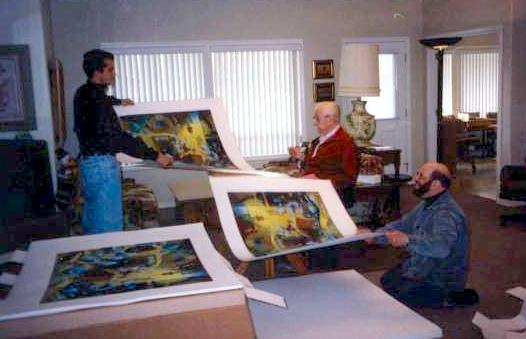
Signature session for the Barks serigraph 141-1994 Rich Finds at Inventory Time
In 1980
Barks was granted another permission (the first one ran from 1971 to
1976) by The Walt Disney Company to paint duck paintings
with two major alterations: 1. The paintings were to be used for
'lifelike' graphic reproductions, and 2. The permission had no
expiration date! The first clause especially had a tremendous impact
on Barks' earnings in his last golden years, because not only was he
very handsomely paid for his paintings, but he often earned more in
signing fees (the lithographs and serigraphs were all signed by
Barks personally) and royalties! |
|
|

Carl and Peggy in late 1923
Carl and his first
wife Pearl had two daughters, Peggy Phyllis (1923-1963) and Dorothy
Louise (1924-), but their parents were separated for several years
before finally divorcing. During the separation the daughters were
raised by Pearl's parents. When the girls became teenagers,
they lived briefly with Carl and his second wife Clara, which proved
to be a bad idea as they could not get along... |
|
|

1973
This small piece of
conversation with his wife presents Barks' general attitude towards
his work:
Garé: Carl,
do you remember that one editor
who used to say to you, 'Why do
you make so much work for
yourself with your stories?
Why don't you just draw one
panel, and then the next, and
pretty soon you've got a complete
story!'
Carl: Sure, he always
used to say, 'You don't need to
take so long for a single story,
why are you so ambitious, why do
your stories always have to be so
original?'. Well, I just
couldn't reconcile that with my
conscience. If I didn't give my
best, I wasn't satisfied with
myself.
|
|
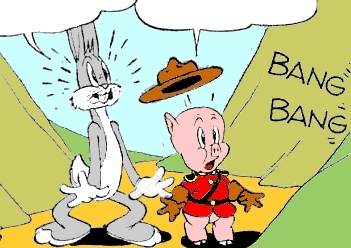
FC0048 Porky of the Mounties
At one time, when Barks was
employed by Western Publishing, he was asked to draw
a variety of characters outside his duck
universe. Oddly enough they originated from different
film companies: Andy Panda (Walter Lantz), Barney Bear and Benny
Burro (MGM), Porky Pig and Bugs Bunny (Warner).
One of the stories, FC0048 Porky of
the Mounties, featured Porky Pig and Bugs Bunny, but
Western found that the rabbit's facial expressions
were so badly done that other artists had to redraw them.
As a result Barks was afterwards freed from making any more stories with the
difficult
character.
As for Porky and Bugs as cartoon characters Barks later offered this
opinion:
Porky Pig I detested, probably because of his stutter. Bugs
Bunny was often very funny in a slapstick sort of way. |
|
|
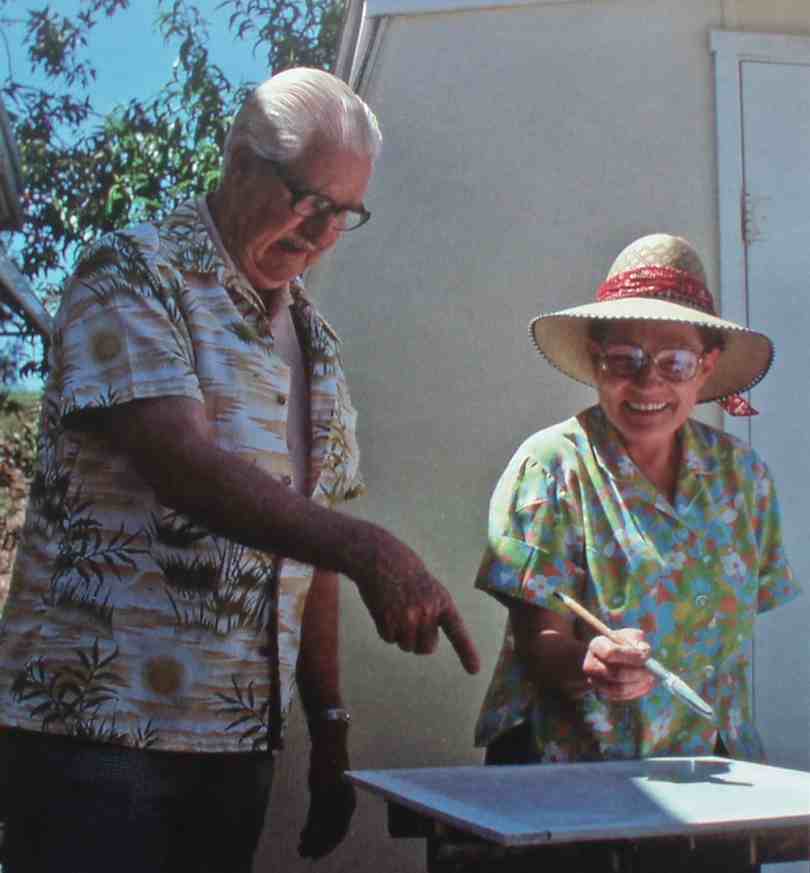
Temecula,
California, 1978
Between
the late 1950s and the early 1970s Barks had a long transitional period in
which he slowly turned from working full-time
on comic book stories to working full-time
on oil paintings. He started to paint
with watercolours, gouache, and oils
under the supervision of his wife, Garé,
who was a very skilled landscape painter.
In the first years Barks mainly painted
portraits of young girls in exotic
surroundings. Then he started to paint
landscapes. But while Garé sold well in
exhibitions and markets in the
neighbourhood, her husband never sold
anything.
Being the realist he was, Barks wound down
his activities in the early 1970s (as he
wrote to a friend: I'll be glad when
Garé earns enough money to support me,
so I can retire for real!). Then he got permission
from Disney to paint the ducks...
|
|
|

WDCS188
'Olympic Tryouts'
Throughout his entire
life Barks had a multitude of problems with his health: After having
contracted measles as a toddler he became hard of hearing and that
condition continuously deteriorated.
Barks also had a number of
allergies; he was lactose intolerant, which made it impossible for
him to digest dairy products properly. He loved milk with his
breakfast cereals, but he had to use milk substitutes. Furthermore,
he had severe bouts with hay fever; he claimed his nose would swell
up like a red balloon. The javelin thrower in WDCS188
'Olympic Tryouts'
is a self-portrait of a hay fever stricken Barks.
Some of the allergies resulted in Barks never
keeping pets, although he was very fond of dogs, particularly
huskies with their expressive faces. But Barks took a
realistic approach to his many physical ails and shortcomings and
learned to live with them.
|
|

